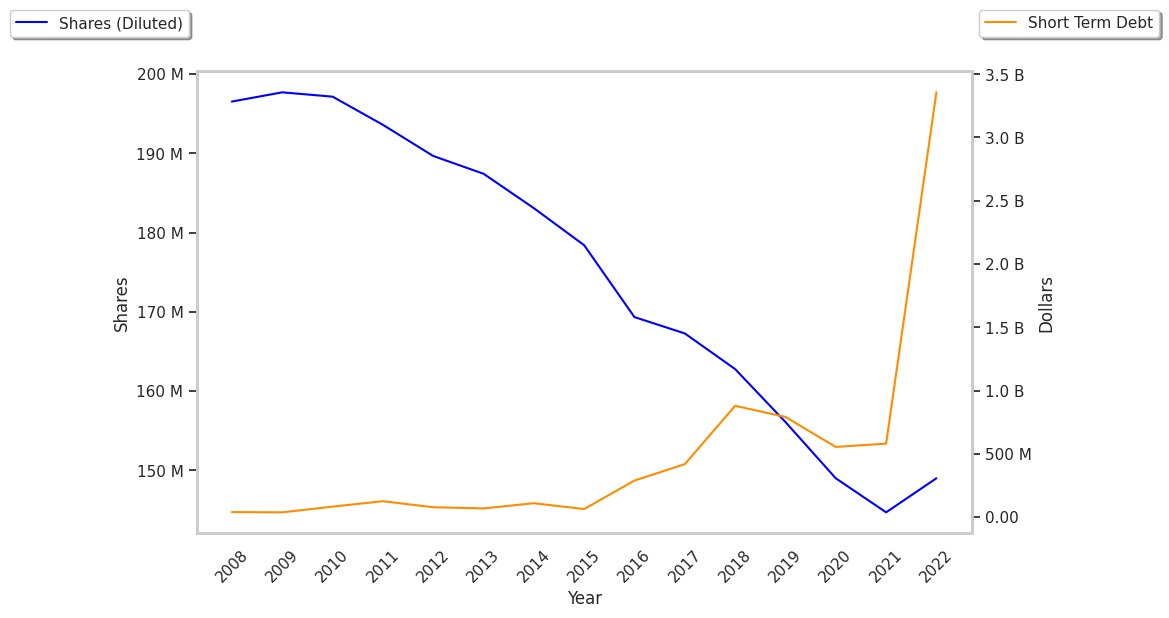
One of Wall Street's biggest winners of the day is Cummins, a farm & heavy construction machinery company whose shares have climbed 3.7% to a price of $725.94 -- near its average analyst target price of $744.33.
The average analyst rating for the stock is buy. CMI outperformed the S&P 500 index by 4.0% during today's morning session, and by 96.6% over the last year with a return of 122.2%.
Cummins Inc. offers various power solutions worldwide. The company belongs to the industrials sector, which generally includes cyclical companies -- with the exception of conglomerates whose business may span several industries. Cyclical companies experience higher sales during periods of economic expanision, and worsening outlooks during recessions.
Cummins's trailing 12 month P/E ratio is 37.7, based on its trailing EPS of $19.25. The company has a forward P/E ratio of 21.4 according to its forward EPS of $33.9 -- which is an estimate of what its earnings will look like in the next quarter.
As of the third quarter of 2024, the average Price to Earnings (P/E) ratio for US industrials companies is 24.03, and the S&P 500 has an average of 29.3. The P/E ratio consists in the stock's share price divided by its earnings per share (EPS), representing how much investors are willing to spend for each dollar of the company's earnings. Earnings are the company's revenues minus the cost of goods sold, overhead, and taxes.
We can take the price to earnings analysis one step further by dividing the P/E ratio by the company’s projected five-year growth rate, which gives us its Price to Earnings Growth, or PEG ratio. This ratio is important because it allows us to identify companies that have a low price to earnings ratio because of low growth expectations, or conversely, companies with high P/E ratios because growth is expected to take off.
Cummins's PEG ratio of 1.68 indicates that its P/E ratio is fair compared to its projected earnings growth. In other words, the company’s valuation accurately reflects its estimated growth potential. The caveat, however, is that these growth estimates could turn out to be inaccurate.
To better understand the strength of Cummins's business, we can analyse its gross profits, which are its revenues minus its cost of goods sold only. The extent of gross profit margins implies how much freedom the company has in setting the prices of its products. A wider gross profit margin indicates that a company may have a competitive advantage, as it is free to keep its product prices high relative to their cost.
CMI's gross profit margins have averaged 24.5% over the last four years. While not particularly impressive, this level of margin at least indicates that the basic business model of the company is consistently profitable. These margins have slightly increased over the last four years, with an average growth rate of 0.4%. Another key to assessing a company's health is to look at its free cash flow, which is calculated on the basis of its total cash flow from operating activities minus its capital expenditures. Capital expenditures are the costs of maintaining fixed assets such as land, buildings, and equipment. From Cummins's last four annual reports, we are able to obtain the following rundown of its free cash flow:
| Date Reported | Cash Flow from Operations ($ k) | Capital expenditures ($ k) | Free Cash Flow ($ k) | YoY Growth (%) |
|---|---|---|---|---|
| 2025 | 3,621,000 | 1,235,000 | 2,386,000 | 755.2 |
| 2024 | 1,487,000 | 1,208,000 | 279,000 | -89.87 |
| 2023 | 3,966,000 | 1,213,000 | 2,753,000 | 163.19 |
| 2022 | 1,962,000 | 916,000 | 1,046,000 | -31.27 |
| 2021 | 2,256,000 | 734,000 | 1,522,000 | -30.63 |
| 2020 | 2,722,000 | 528,000 | 2,194,000 |
- Average free cash flow: $1.7 Billion
- Average free cash flown growth rate: 5.1 %
- Coefficient of variability (the lower the better): 0.0 %
With its positive cash flow, the company can not only re-invest in its business, it can offer regular returns to its equity investors in the form of dividends. Over the last 12 months, investors in CMI have received an annualized dividend yield of 1.1% on their capital.
Another valuation metric for analyzing a stock is its Price to Book (P/B) Ratio, which consists in its share price divided by its book value per share. The book value refers to the present liquidation value of the company, as if it sold all of its assets and paid off all debts.
Cummins's P/B ratio indicates that the market value of the company exceeds its book value by a factor of 8, so the company's assets may be overvalued compared to the average P/B ratio of the Industrials sector, which stands at 2.89 as of the third quarter of 2024.
Cummins is by most measures undervalued because it has a higher P/E ratio than its sector average, a higher than Average P/B Ratio, and generally positive cash flows with an upwards trend. The stock has mixed growth prospects because it has a an inflated PEG ratio and decent operating margins with a stable trend. We hope you enjoyed this overview of CMI's fundamentals.